




Real estate is much broader than bricks and mortar. In fact, if you open your eyes, you’ll realize that one of the largest pools of real estate sits right inside the stock market.
Is Real Estate Investing Only About Buying Property?
When people hear the phrase real estate investing, their minds often jump to buying land, building houses, or owning rental apartments.
That’s the picture most of us grew up with, and it’s not wrong—but it’s incomplete.
Think about it. Every company listed on the stock exchange is tied to real assets.
How is the Stock Market Connected to Real Estate?
Behind every share ticker you see on a trading screen is land, infrastructure, and property anchoring that business:
- Banks own headquarters and branch networks.
- Retail giants manage warehouses, malls, and logistics centres
- Oil and gas companies control drilling fields, refineries, and land reserves
- Even the futuristic players in artificial intelligence, cloud computing, and digital platforms need sprawling data centres, research labs, and office campuses.
In this sense, the stock market is not just a sea of numbers; it is a vast form of digital real estate.
When you buy a share, you are not just purchasing “paper.” You’re acquiring a fractional stake in the very real assets that make up the global economy.
Why Saving to Buy a Property Could Be Your Biggest Financial Mistake
Here’s where the irony kicks in:
Many investors rush to buy a single rental property as their badge of entry into real estate, yet their stock portfolios often contain more real estate exposure than that one property could ever represent.
And the bigger problem? Many don’t even have the financial capacity to buy that property outright.
They spend years—or even decades—saving and wishing, while inflation and rising prices quietly eat away at their dream.
This is a costly mistake.
Why?
The Power of Time Value of Money in Real Estate Wealth Building
Because of the principle of the time value of money: money invested today has the power to grow into multiples tomorrow.
Money locked away in endless saving, on the other hand, loses value.
By the time many “hopeful landlords” finally save enough, property prices have soared, their money buys less, and the dream slips further out of reach.
There’s a smarter way forward.
Instead of waiting for a mythical breakthrough, investors can steadily build their equities portfolio.
This approach gives them indirect ownership of real estate through the companies they invest in, while compounding their money at a faster pace.
What could take twenty years of slow saving for a property could, with disciplined investing, be achieved in a fraction of the time.
Imagine the economy giving back to you regularly all year round, offering you financial relief as a reward for the money you spend.
How would it feel to receive your own steady stream of palliatives, a sign of appreciation for your contributions to the economy?
Imagine creating your personal economy independent of your salary cycle.
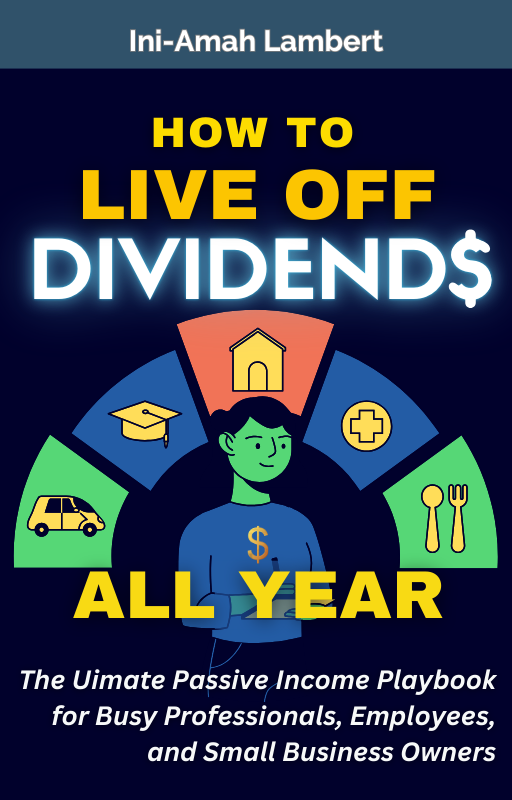
We have detailed how to do this in a step-by-step, no-fluff 60-page manual that would take you just one lunch break to digest.
Follow the simple system of strategies we show you and you can live off dividends all year round—and even own prime real estate properties with a modest income.
It’s like having a money tree in your room — ready to pluck free salary whenever you need it.
Why the Stock Market is the Biggest Real Estate Market: Case Studies
The stock market is, in many ways, the grandest real estate market in existence, mapping ownership to land, property, and infrastructure across industries and continents.
Let’s ground this idea with real-world examples:
Real Estate Investment Trusts (REITs)
A REIT pools investor funds to buy and manage properties—shopping malls, office complexes, residential blocks—and then distributes rental income back to shareholders.
On both the global and Nigerian markets, REITs provide perhaps the clearest bridge between traditional real estate and equities.
In short, REITs make it possible for an investor with modest capital to co-own prime properties that would otherwise be out of reach.
For instance…
SFSREIT (NGX)
If you invest in SFSREIT, you will be a co-owner of the following prime properties:
1. Victory Park Estate, Igbokushu, Lekki
2. Milverton Court Estate, Osapa, Lekki
3. Sapphire Gardens Estate, Awoyaya, Lekki
4. Bourdillion Court Estate, Chevron, Lekki
5. Cromwell Estate, Chevron Drive, Lekki
6. Maben Estate, Lekki
7. Victoria Crest, VGC, Lekki
Amazon (Global):
Known as an e-commerce and cloud giant, Amazon is, in reality, one of the largest landlords in the world. Its massive network of fulfilment centres, warehouses, and data facilities stretches across continents. Buying Amazon stock means owning a slice of this real estate empire.
ExxonMobil (Global)
Oil companies like ExxonMobil are custodians of land reserves, oil fields, and refineries. Owning shares gives you fractional ownership of these physical assets, which often span multiple countries.
Okomu Oil Palm (Nigeria)
Listed on the Nigerian Exchange (NGX), Okomu Oil is not just a palm oil producer—it is a land giant.
The company controls thousands of hectares of plantations in Edo State. Investors who hold Okomu shares indirectly own a stake in that land, which is as real and tangible as any plot in Lagos or Abuja.
Presco Plc (Nigeria)
Similarly, Presco is another plantation estate. With its vast palm oil estates and processing plants, its shares are essentially tickets into large-scale agricultural real estate—arguably one of the most overlooked forms of property investment.
UACN (Nigeria)
United Africa Company of Nigeria is a diversified conglomerate with holdings in real estate development, retail, logistics, and food businesses.
Through UACN’s property subsidiaries and land banks, shareholders enjoy exposure to prime real estate scattered across Nigeria’s commercial hubs.
This is the mindset shift:
The stock market, in many ways, is the grandest real estate market in existence, because it maps ownership to land, property, and infrastructure spread across industries and continents.
Equities are not a lesser asset class to be endured until you can “finally buy real estate.”
They are a bridge to your real estate ambitions—a tool to accelerate your journey rather than delay it.
So, make no mistake, real estate investing is more than land titles and apartment blocks.
The world’s biggest landlords are not always those who hold deeds; they are also those who hold shares.






Leave a Reply