



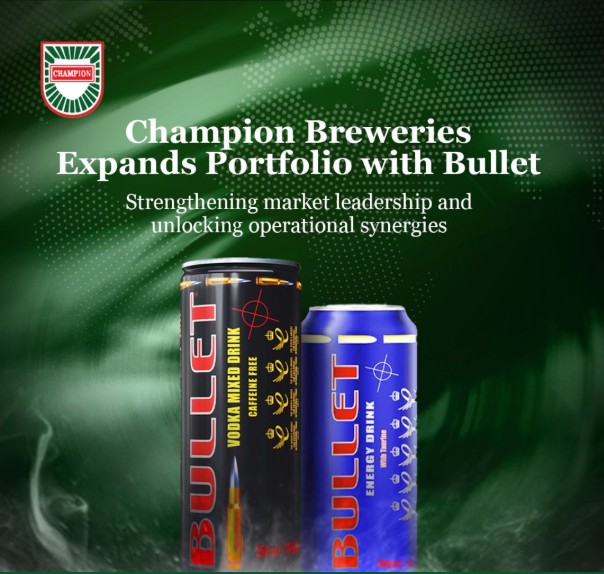
Champion Breweries Plc is making a bold move that could reshape Nigeria’s beverage landscape. The company, known for its beer products, has agreed to acquire the Bullet brand assets from Sun Mark International Limited, a UK-based FMCG company.
This deal goes beyond adding a new product—it marks Champion’s entry into the fast-growing energy drink market, while also expanding its alcoholic beverage portfolio.
Let’s break down what this means for the brand, consumers, and the Nigerian market.
QUICK TAKEAWAYS
✅ What Happened: Champion Breweries acquires Bullet brand rights from Sun Mark.
✅ Deal Structure: Asset carve-out; new Dutch company jointly owned with Vinar V.N.
✅ Strategic Value: Diversification + entry into Nigeria’s booming energy drink market.
✅ Opportunities: Global rights, export potential, reduced reliance on beer market share.
✅ Risks: Production shift, ingredient sourcing, capex, logistics, and competition.
✅ Consumer Impact: More choice, possible better pricing, and local availability.
✅ Big Picture: If well executed, this deal could transform CHAMPION into a leading West African beverage player.
Nigerian Stock Market Q2 2026 Playbook: How to Move Ahead of the Market Herd
What Exactly Happened?
Champion Breweries has secured the rights to Bullet’s trademarks, recipes, and distribution rights.
The Champion–Bullet deal isn’t structured as a traditional “buy and absorb.” Instead, it uses what finance professionals call an asset carve-out.
What is an Asset Carve-Out?
An asset carve-out happens when a company buys only a specific business unit, product line, or set of assets from another company—rather than acquiring the whole company.
The carved-out assets are often transferred into a new legal entity, which is then co-owned by the buyer and sometimes the seller.
That’s exactly what is happening here:
-
Bullet’s brand assets—including trademarks, recipes, and distribution rights—will be moved into a new company in the Netherlands.
-
Ownership of this company will be split between Champion Breweries (majority) and Vinar N.V., a Belgian company tied to Sun Mark.
This structure allows Champion to focus on the Bullet portfolio without taking on the entire Sun Mark business.
This is similar to what GTCO once did with Investment One, carving out a part of its business into a separate vehicle while retaining strategic control.
Also read:
MTN Nigeria Dividend 2026: Full Breakdown of MTNN’s ₦20 Per Share Payout for 2025 Financial Year
Mastering the 4 Core Levers of Investing
Why You Should Have Manufacturing & Consumer Goods Companies on the NGX in Your Portfolio
Why This Deal Matters
1. Champion Diversifies Beyond Beer
For years, Champion has been mainly a beer-focused company. Adding Bullet gives it new revenue streams and reduces dependence on a single category.
Champion also noted that the transaction is subject to regulatory approvals, including clearance from the Federal Competition and Consumer Protection Commission (FCCPC).
If approved, Champion will be able to consolidate Bullet’s assets into its financial statements. This means immediate gains from foreign exchange earnings and distributor reach, plus longer-term benefits from supply chain integration, product diversification, and a stronger market presence.
2. Tapping Into a Growing Energy Drink Market
Energy drinks are booming globally—and Nigeria is no exception. A young, energetic population is driving demand, making this one of the most attractive beverage segments. With Bullet already well-known, Champion gets a head start.
3. Global Expansion Potential
By owning Bullet’s global rights, Champion isn’t limited to Nigeria but backed by Africa-Wide Presence. The company can explore export opportunities and position itself as a West African beverage player, not just a regional brewer.
Bullet already has a strong presence across 14 African markets, including Nigeria, Cameroon, Ghana, Ivory Coast, the Democratic Republic of Congo, and Tanzania.
In Nigeria, Bullet Black is the leading ready-to-drink beverage, while Bullet Blue ranks among the top six energy drink brands.
Notably, energy drinks have continued to defy Nigeria’s broader consumer slowdown, with rising youth demand and the product’s deep connection to nightlife and entertainment culture driving strong sales growth.
Also Read:
Understanding the 3 Major Investment Objectives: How to Know Yours
The Challenges Ahead
While the deal is exciting, Champion will need to overcome a few hurdles:
-
Production Shift: Brewing beer is very different from making energy drinks. Champion must invest in new production lines to maintain Bullet’s taste and consistency.
-
Ingredient Sourcing: Bullet’s original inputs—like taurine and caffeine—may not be readily available in Nigeria. Any change in formulation could affect consumer perception.
-
Capital Investment: Upgrading facilities in Uyo to produce Bullet could be costly, stretching Champion’s balance sheet.
-
Distribution Adjustments: Energy drinks move faster and in smaller cans compared to beer crates. Champion’s logistics network may need restructuring.
-
Competition: The Nigerian energy drink market already has big players like Red Bull, Monster, and Fearless. Bullet will need strong marketing to stand out.

What This Means for Consumers
For everyday Nigerians, this could mean:
-
More choices in the energy drink and alcoholic beverage market.
-
Potentially better pricing, as more competition often drives affordability.
-
A chance to see local production of a global brand in Nigeria, which may improve availability.
Financial Snapshot of Champion Breweries
-
Earnings: Profits of around ₦1 billion, with steady growth.
-
Balance Sheet: Low debt and strong cash reserves.
-
Cash Flow: Consistently positive, even during the pandemic.
-
Market Value: Currently valued at about ₦180 billion, though trading at a high P/E ratio.

What Champion Breweries’ Acquisition of Bullet Means For Investors
-
Short-Term: The stock has already reacted to the acquisition news, and markets usually price in such excitement quickly. Investors may see some volatility until real results show.
-
Medium-Term: Earnings from Bullet may take time to reflect, especially if Champion still relies on Sun Mark’s facilities before shifting production locally.
-
Long-Term: If Bullet climbs into Nigeria’s top 3 energy drink brands, Champion’s valuation could expand significantly. But if integration struggles, the share price could retrace.
In conclusion: this acquisition could be a growth catalyst, but success depends heavily on execution.
Investors should watch for updates on production capacity, distribution improvements, and actual sales growth of Bullet in Nigeria.






Leave a Reply