



What’s the Difference Between Angel Investors and Venture Capital Investors?
Angel investors play a vital role in funding early-stage companies, bridging the gap that venture capitalists often overlook.
Whether you’re a founder seeking funding for your start-up or simply curious about the world of private equity investing, understanding the difference between angel investors and venture capital investors (VCs) is crucial.
These two investor types sit at opposite ends of the private equity spectrum, and choosing the right one can make or break your funding journey.
In this guide, we break down exactly who angel investors and venture capitalists are, how they differ, where they overlap, and, most importantly, how to determine which type of the two investors you are or which investor is right for your business stage.
Also Read
7 Grave Mistakes Parents Make Saving for Their Kids Education (How to Avoid Them)
Understanding the 3 Major Investment Objectives: How to Know Yours
Master the 4 Core Levers of Investing (and 5 Hidden Multipliers for Financial Freedom)
Who Is an Angel Investor?
An angel investor (sometimes called a “business angel”) is typically a high-net-worth individual who invests their own personal money into early-stage start-ups in exchange for equity ownership or convertible debt.
They often step in during a company’s earliest and most vulnerable phase: the seed round, when the business may be little more than an idea or a prototype.
An Angel Investor can be a:
- Successful entrepreneur who wants to give back to the start-up ecosystem
- Professional such as lawyer, doctor, athlete, or executive with surplus capital
- Friend or family member who believes in the founder’s vision
- Former industry insider with deep domain expertise
What sets angel investors apart is their motivation.
As entrepreneur and angel investor Terri Maxwell has noted, angels are often driven by passion or mission. They want to fund early-stage concepts in industries they genuinely care about, seeking what might be called “meaningful money”: investments that are both financially rewarding and personally fulfilling.
What are the Requirements to Be an Angel Investor?
An Angel Investor has to be an accredited investor. The U.S. Securities and Exchange Commission (SEC) has a standard for “accredited investors”—individuals or couple with a net-worth of at least $1 million and an annual income of at least $200,000 ($300,000 for joint income).
Most angel investors meet this definition, though it is not a strict legal requirement for angel investing.
Who is a Venture Capital Investor?
A venture capital (VC) investor is a professional investor who works within an investment firm or fund, deploying pooled capital from multiple sources (not their own money).
These sources typically include high-net-worth individuals (HNWIs), pension funds, university endowments, investment clubs, corporations, and family offices, all acting as “limited partners” (LPs) in the fund.
The VC firm’s “general partners” (GPs) manage the fund. They raise capital, identify promising start-ups, conduct due diligence, and actively work with portfolio companies to drive growth and returns.
Most VC firms operate on the classic “Two and Twenty” model: a 2% annual management fee on assets under management, plus 20% carried interest on profits generated.
Unlike angel investors, VCs are accountable to their LPs, which means they follow rigorous, structured processes when evaluating and managing investments.
They typically get involved during later funding stages—Series A and beyond—when a start-up has already demonstrated some traction and is ready to scale rapidly.
The Private Equity Spectrum: Where Angels and VCs Meet
It’s important to understand that angel investors and venture capitalists don’t exist in two entirely separate worlds—they exist on a spectrum.
At one extreme, you have the informal “mom-and-pop” angel: a friend or family member writing a small check out of personal trust in the founder.
At the other extreme, you have institutional mega-funds like SoftBank’s Vision Fund, managing hundreds of billions in capital.
In the middle of this spectrum, you’ll find investors who blur the lines between the two categories:
- Angel syndicates: Groups of angels who pool their capital to make larger, more institutional-style investments.
- Super angels: Prolific individual investors who write larger checks and invest across many more deals than a typical angel, often operating with VC-like discipline.
- Micro-VCs: Small venture firms that invest at seed stage with cheques similar in size to angel investments, but with the governance structures of a VC firm.
- Corporate venture capital (CVC): Corporate arms of large companies that invest in start-ups for strategic as well as financial reasons.
As you move toward the centre of the private equity spectrum, the distinctions between angel investors and VCs become increasingly blurred—and increasingly less important.
What matters most is finding an investor whose capital, expertise, network, and involvement style aligns with where your company is today and where you’re trying to take it.
What are the 9 Key Differences Between Angel Investors vs. Venture Capitalist Investors?
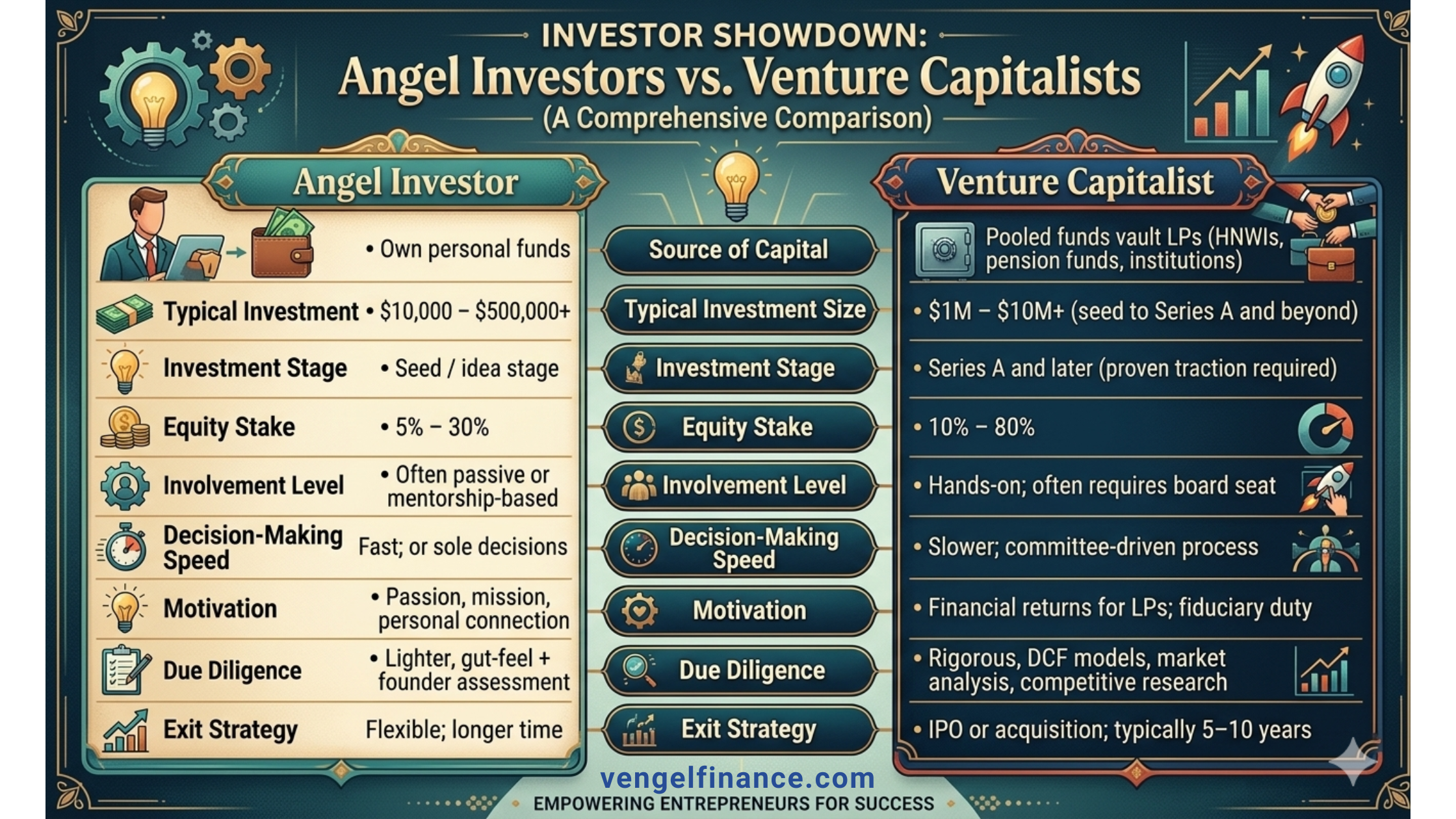
The 9 key differentiators of Angel Investors and Venture Capitalist Investors include: 1. Source of Capital, 2. Investment Size, 3. Investment Stage, 4. Equity Stake, 5. Level of Involvement, 6. Decision-Making Speed, 7. Motivation, 8. Due Diligence, 9. Exit Strategy
1. Source of Capital: Their Own Money vs. Other People’s Money
This is the single most fundamental difference between angel investors and venture capitalists.
Angel investors deploy their own personal wealth. This gives them complete autonomy—they answer to no one and can invest on a whim, based on a gut feeling, a personal relationship, or a mission they care about.
VCs, by contrast, are stewards of other people’s capital. They have a fiduciary responsibility to their limited partners, which demands structured governance, rigorous due diligence, and disciplined investment theses.
This accountability fundamentally shapes how VCs operate—more process-driven, more metric-focused, and more formal in their governance expectations from portfolio companies.
2. Investment Size: From Thousands to Millions
Investment size is another major differentiator. Angel investors typically invest between $5,000 and $500,000, though amounts vary widely.
According to the 2024 Angel Funders Report, the average investment per deal by angel groups was $243,000, with a median of $104,000. When angels collaborate in syndicates, their combined investment can exceed $750,000.
Venture capital operates at a much larger scale. Seed rounds from VC firms average around $1.2 million, early-stage rounds average $4.5 million, and later rounds can reach $10 million or far beyond.
In Q3 2024 alone, $20.1 billion in venture capital was raised across more than 1,250 start-up transactions on the Carta platform—illustrating just how substantial the VC ecosystem has become.
3. Investment Stage: Seed vs. Scale
Angels thrive in the fog of early-stage uncertainty. They are typically the first professional money into a business—often before there is a product, revenue, or even a formal business plan.
Their willingness to bet on founders and ideas, rather than metrics and milestones, makes them uniquely valuable at the seed stage.
VCs, constrained by their accountability to LPs and the need for outsized returns across a portfolio, generally require evidence of traction before writing a check.
They want to see product-market fit, early revenue, a growing customer base, or at minimum, a compelling proof of concept. This is why VCs typically lead Series A rounds and beyond—after angels have helped a start-up find its footing.
A helpful way to think about it: angel investors often “find” the opportunities that VCs later want to invest in.
4. Level of Involvement: Mentor vs. Board Member
Angel investors vary widely in their level of involvement. Some are entirely passive, content to receive an equity stake and watch from the side-lines.
Others become active mentors—sharing their networks, domain knowledge, and personal experience to help founders navigate early-stage challenges. Crucially, they rarely demand formal governance control.
Venture capitalists, on the other hand, typically take a much more hands-on role.
Many VC firms require a seat on the company’s board of directors as a condition of investment, giving them direct influence over strategic decisions, executive hiring, and exit planning.
This level of involvement can be a double-edged sword for founders: valuable strategic guidance on one side, reduced autonomy on the other.
5. Equity Stakes: How Much of Your Company Will You Give Up?
Angels typically take equity stakes ranging from 5% to 30%, reflecting the high-risk nature of seed-stage investing and the relatively smaller cheque sizes. They also tend to receive minimal or no voting rights, preferring an advisory rather than operational role.
VC equity stakes can range from 10% to 80%, depending on the stage and the amount invested.
Because VCs deploy larger sums and have a fiduciary duty to generate strong returns, they often push for substantial ownership positions. They also receive operational voting power, which underpins their ability to influence company direction and governance.
6. Decision-Making: Speed and Due Diligence
One of the most practical differences for founders is the speed of decision-making.
Angel investors, investing their own money, can make a decision in a matter of days—sometimes over a single coffee meeting. Their due diligence tends to be lighter and more relationship-driven, focusing on the founder’s background, passion, and the potential for disruptive innovation.
VC firms follow a committee-driven process that can take weeks or months.
They apply structured analytical frameworks—discounted cash flow (DCF) models, comparable company analyses, market sizing exercises, and extensive reference checks.
This rigor is necessary given the scale of capital and the complexity of LP accountability.

Angel Investor or Venture Capitalist: Which Is Right for Your Start-up?
There is no universally correct answer—the right choice depends on your company’s stage, capital needs, and strategic vision. Here’s a practical framework:
Choose an Angel Investor If:
- You’re at the idea or prototype stage, with no or minimal revenue
- You need a smaller cheque ($10K–$500K) to reach your next milestone
- You want to preserve operational autonomy and avoid formal board oversight
- You value mentorship, introductions, and a personal relationship over institutional resources
- Speed and flexibility in funding are critical to your timeline
Choose a Venture Capitalist If:
- You’ve achieved product-market fit and have early traction or revenue
- You need $1M+ to scale operations, hire, and capture market share aggressively
- You’re comfortable with board oversight and institutional governance
- You want access to a deep network of resources, follow-on capital, and strategic partners
- You’re building a company targeting a large (ideally $1B+) total addressable market
Angel investors and venture capitalists are both essential pillars of the start-up financing ecosystem—but they serve very different purposes at very different stages. Angels are the brave early believers, willing to bet on a founder’s vision before the world can see it.
VCs are the institutional amplifiers, providing the scale capital and structured support needed to turn promising start-ups into market leaders.
Understanding these differences is not just academic—it’s a practical superpower for any founder navigating the fundraising landscape.
Know where your company sits on the private equity spectrum, know what kind of investor aligns with your current needs, and approach your fundraising strategy accordingly.
The right investor at the right stage can accelerate everything. The wrong one—however well-intentioned—can complicate it.





Leave a Reply