




The Q2 2026 NGX Playbook: How to Invest in the Nigerian Stock Market in Q2 2026 Before the Market Herd Figures It Out
The S&P 500—the benchmark for the US stock market—just handed Nigerian investors a map.
Not a map of America. A map of where global capital is going next. In this article, we x-ray what it’s saying, and how to use it on the Nigerian market before local funds catch on.
Here’s what the data says:
The 10 best-performing S&P stocks in Q1 2026 were oil producers, chemical companies, fertiliser makers, and semiconductor infrastructure.
The 10 worst were high-flying SaaS businesses, ad-tech platforms, and premium fintech names.
That gap—between who won and who lost—is not random noise. It is a signal.
Behind the Scenes of this Article:
The US Stock Market in Q1 2026 Retrospect
Q1 2026 just ran an experiment. The results were loud.
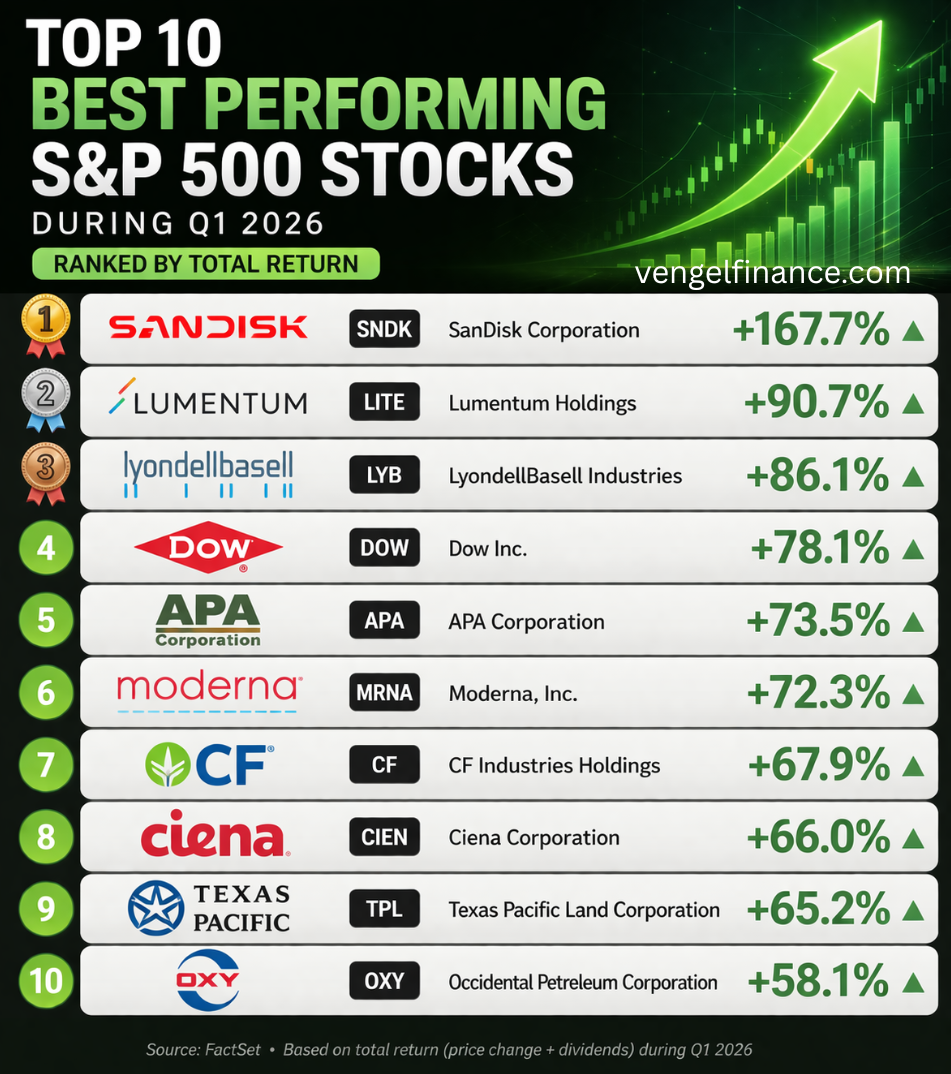
What are the Top 10 Best Performing Companies on the S&P 500 in Q1 2026?
The top ten best-performing stocks on the S&P this quarter were oil producers, chemical companies, fertiliser makers, and semiconductor infrastructure builders. Sandisk surged 167%. LyondellBasell—a chemical giant—was up 86%.
CF Industries, a fertiliser company, gained 68%. Occidental Petroleum rose 58%.
What are the Top 10 Worst Performing Companies on the S&P 500 in Q1 2026?
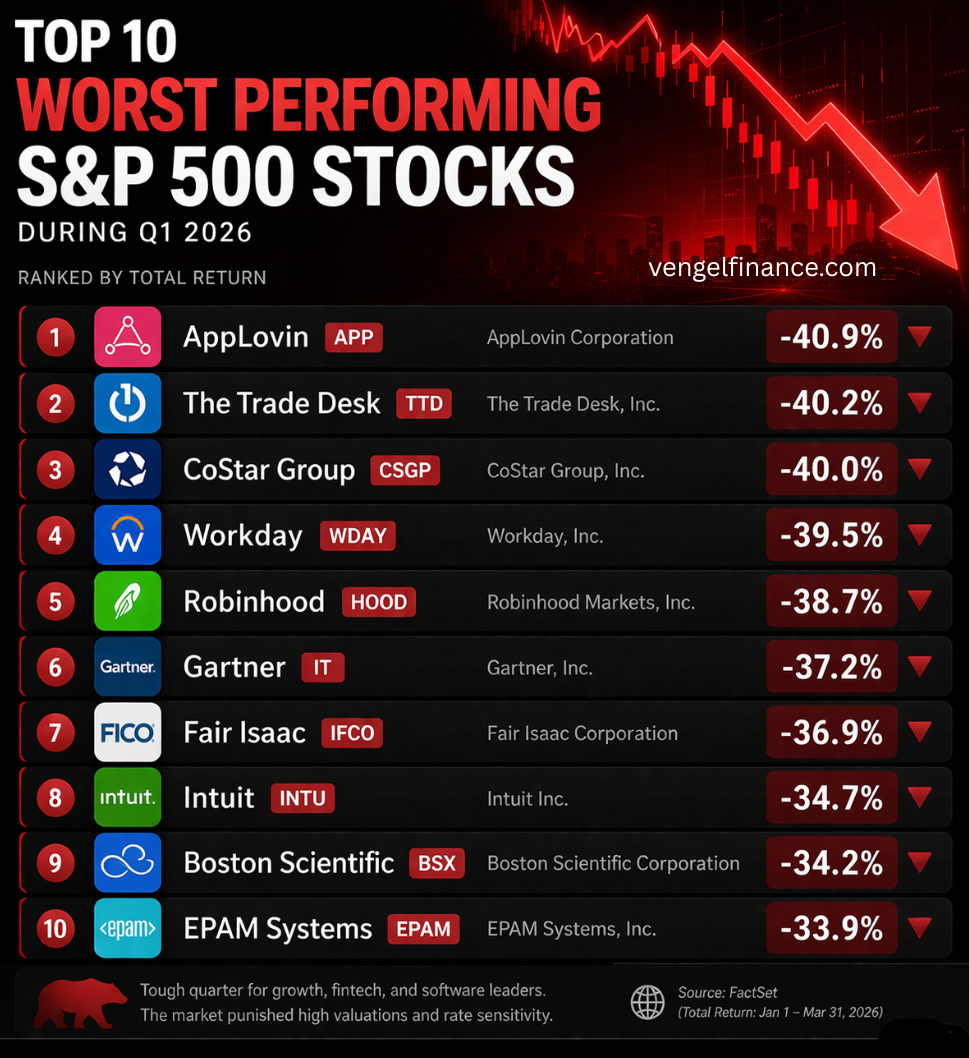
The top ten worst performing companies on the S&P 500 in the first quarter of 2026 are: AppLovin, Trade Desk, Workday, Intuit, Robinhood.
All software. All “future earnings” stories. All down between 34% and 41% in a single quarter.
That gap is not an accident. And it is not just an American story.
What the S&P 500 is Actually Telling You
It tells you which kinds of businesses investors trust with their money, and which ones they are quietly walking away from.
“Investors are selling companies whose value lives in a spreadsheet. They are buying companies that produce something real, right now.”
There is a shift happening in how global capital is being allocated. It is a shift from what you might call future expectations—projections, 10-year discounted cash flow models, promises of profitability “at scale”—toward present reality: companies that generate cash flow now, companies tied to hard assets, companies in businesses where scarcity sets the price.
Oil in the ground. Urea in a warehouse. Palm oil in a tank. A fibre-optic cable lit up and moving data across a continent. These are not stories. These are things.
When interest rates stay elevated—which they have—the math shifts. The further out in the future a company’s earnings are projected, the more those future earnings are discounted in today’s calculation.
Suddenly, a SaaS company trading at 40 times earnings looks expensive in a way it didn’t when rates were near zero. Suddenly, a fertiliser company trading at 8 times earnings and generating real dollars from real exports looks like a bargain.
That is the rotation. Capital out of imagination, into substance.
Why This Matters for the NGX Specifically
Here is the part most Nigerian retail investors miss.
When global capital decides it prefers oil companies, it doesn’t just buy ExxonMobil. It reprices everything connected to oil—including the underlying commodity, including the sentiment around energy markets globally, including the Nigerian E&P companies listed on the NGX that produce the exact same barrel.
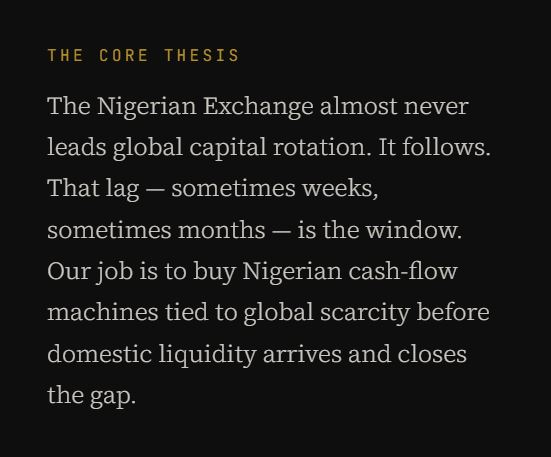
The mechanism is this: global rotation happens first on the S&P. Then foreign portfolio investors, who also hold African assets, begin rebalancing toward the same themes on frontier markets.
Then local institutional funds—pension funds, insurance companies—read the earnings reports and start moving. Then domestic retail liquidity arrives last.
Each step in that chain is an opportunity for the person who saw it coming. We are trying to be at step one. Most people arrive at step four.
What is the Q2 2026 NGX Playbook?
With that framework established, here is how we are thinking about the specific opportunities on the Nigerian Exchange heading into the second quarter of 2026.
1. Energy: The Move Had Started, But It Is Not Yet Game-Over
The S&P’s energy winners—APA Corp (+73.5%), Occidental (+58.1%), Texas Pacific Land (+65.2%)—had one thing in common: they were real asset businesses with proven reserves, generating cash at the current oil price, without needing oil to go higher to make the investment work.
On the NGX, the equivalent trade has already begun. The NGXOILGAS index is up more than 31% year-to-date in 2026.
Seplat Energy and Aradel Holdings have led the rally. But a sector being up 31% doesn’t mean it’s done—it means the obvious names are crowded. The less crowded angles are where the remaining alpha lives.
The structural catalyst to monitor: Seplat’s ANOH Gas Plant began production in January 2026, processing up to 300 million standard cubic feet per day. This is not a one-quarter event. It is a multi-year revenue engine. Eterna and Conoil are downstream operators that have not yet moved at the same pace as the heavyweights—less crowded, still repricing.
The other energy wildcard that could change the entire NGX landscape: the anticipated Dangote Petroleum Refinery IPO. Underwriters have been formally appointed.
When it lists, it will be one of the largest equity offerings in NGX history, and it will pull capital, attention, and institutional money toward the entire energy sector.
You want to be positioned in the sector before that gravity kicks in.
Ready to Become a Growth Investor, Diversify Your Portfolio and Move to Alpha Returns?
Join our Venture Capital Syndicate and gain exclusive access to private deals, early-stage start-ups, and scalable companies before they go public. Invest alongside experienced operators and capture exponential growth opportunities.
- Access vetted start-up and private equity opportunities
- Collective due diligence & expert guidance
- Potential for exponential returns (10x+)
Spots are intentionally limited to preserve high-quality deal flow. Secure priority access now.
2. Fertiliser & Chemicals—The Biggest Unmapped Opportunity
This is where we think the cleanest alpha is hiding on the NGX right now, and it is hiding precisely because most investors haven’t made the connection yet.
CF Industries—a US fertiliser company—returned 68% in a single quarter. LyondellBasell returned 86%. Dow returned 78%.
These are not technology companies. They are companies that manufacture things the world needs: urea for crops, chemicals for industrial processes, materials that go into the physical economy.
When the rotation toward hard assets begins, they reprice fast.
Nigeria has direct equivalents. And they are underpriced.
NASCON Allied Industries is a Dangote Group company that processes salt and industrial inputs. It currently trades at a price-to-earnings ratio of approximately 7.7x—against a sector average of 13.7x. That is nearly half the sector valuation, for a company that makes something real and generates real earnings. That gap is the mispricing. It is the LyondellBasell trade before the market noticed LyondellBasell.
Dangote Fertiliser is the largest direct analogue to CF Industries on this continent. It is Africa’s biggest urea exporter. It operates on dollar-denominated revenues in a naira economy—meaning investors get commodity-linked, FX-protected exposure. It is not yet listed on the NGX. When/if the IPO window opens, that is the event to be positioned for.
3. Palm Oil—Real Assets, Careful Entry
There is no direct S&P equivalent here. But the logic is identical to every winning theme this quarter: scarce, physical, globally priced commodities.
Nigeria’s palm oil plays—Presco and Okomu Oil—have been the NGX’s version of the hard-asset commodity trade. Okomu hit an all-time high in March 2026. Presco has returned over 200% in the past year. Analysts project Okomu’s profit margin to reach 52.6% in 2026. The fundamentals remain genuinely strong.
But the easy money here has already been made. If you bought in 2024 or early 2025, congratulations. If you are looking to enter now, near all-time highs, you need to be honest with yourself: you are not early. You need to consider opportunity cost and apply patience.
Strong fundamentals, strong commodity tailwinds, but ATH valuations. Hold if you own them.
New entry on dips only—on a broader market pullback, on a temporary dip in global Crude Palm Oil prices. Watch global crude palm oil price data monthly as the primary trigger.
The thesis is intact. The entry point is the question.
4. Telecom Infrastructure—The “Pipes” Trade
One of the most precise lessons from this quarter’s S&P rotation: in an AI and data-saturated economy, the infrastructure layer wins before the application layer.
Ciena—a fibre optics company—gained 66%. Lumentum—which builds the photonic chips that power AI data centres—gained 90%. Meanwhile, AppLovin and Trade Desk, which use AI to run ad-targeting businesses, each fell over 40%.
Same technology era. Opposite outcomes. The market is saying: own the pipe, not the water.
On the NGX, MTN Nigeria is the pipe. It is the backbone through which nearly every digital transaction, every mobile payment, every data packet in Nigeria flows. Its MoMo fintech arm is optionality.
At roughly 55% year-to-date growth by early March and still trading at valuations well below global telecom peers, MTN has not finished repricing… learn more.
Watch for NCC regulatory decisions and Q1 2026 earnings from MTN Nigeria. Airtel Africa offers dual-listed exposure with additional currency diversification. The thesis: own the infrastructure before the fintech layer fully prices in.
5. What to Underweight This Quarter
The S&P rotation punished companies where today’s share price is built on tomorrow’s promise. That dynamic does not stay in America. It travels.
On the NGX, the equivalent risk sits in premium consumer brands that carry high multiples and cost structures that haven’t fully adjusted to Nigeria’s new macroeconomic reality.
The market is beginning to ask the same question it asked on Wall Street: why am I paying this price for a business whose earnings don’t justify it?
Yesterday’s session confirmed the direction: Nestlé Nigeria hit its daily -10% limit. This is not necessarily a company problem. It maybe a valuation and rotation problem—the same logic that sent Intuit down 35% and Workday down 39% on the S&P. Capital going into NASCON is coming from somewhere.
Summary
The global rotation happening on the S&P 500 is not an American story. It is a macro story—a fundamental repricing of what capital values in a world of persistent inflation, elevated rates, and growing resource scarcity.
Nigeria’s oil, its gas, its palm oil, its fertiliser, its telecommunications infrastructure—they all exist within that same world.
The NGX will catch up to this rotation. It always does.
The All-Share Index crossed 200,000 points in Q1, making it one of the best-performing markets in the world in dollar terms. That is not a coincidence. That is a frontier market waking up to global themes.
The reckoning isn’t whether this article plays out and the rotation reaches the NGX or not. The only thing that matters is whether you are positioned before it fully arrives—or whether you’re reading about it in next quarter’s results, wondering why you didn’t move when the signals were this clear.

DISCLAIMER: This article is for informational and educational purposes only. It does not constitute financial advice, investment advice, or a solicitation to buy or sell any securities. All investments carry risk, including the risk of total loss of capital. Past performance does not guarantee future results. NGX-listed securities are subject to liquidity risk, currency risk, and regulatory risk. Please conduct your own independent research and consult a licensed financial adviser before making any investment decisions. Vengel and her clients hold positions in some of the securities mentioned.






Leave a Reply