



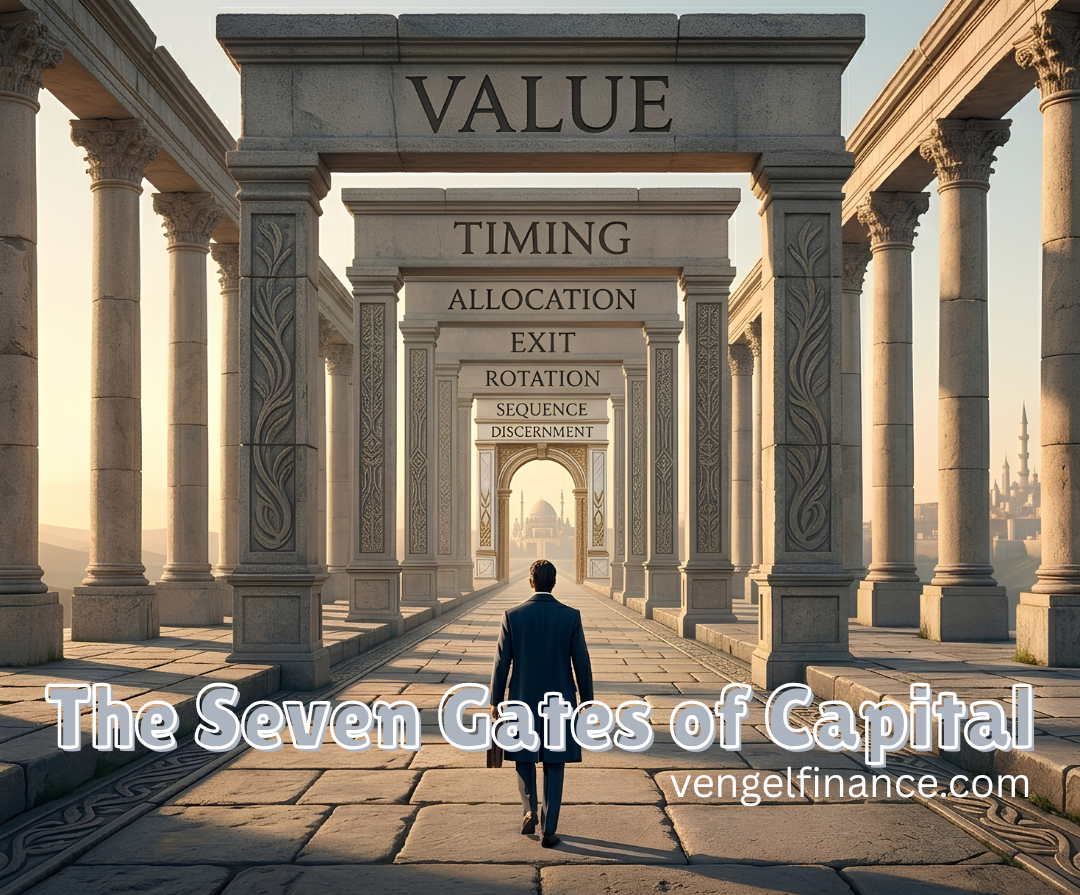
What’s the 7 Holy Grails of Investing?
The seven holy grails of investing (7HGI) is a codified process—the 7 gates of capital, a sevenfold rite of passage in investing.
The Framework
The 7HGI is not recycled motivation. It is a codified process built on the understanding that every wealth-destroying mistake an investor makes can be traced back to one cause: the wrong action, at the wrong time, in the wrong order.
Most investors fail not because they lack intelligence, but because they lack sequence. They want to cut corners.
They hear a good idea and act,
They see a rising stock and buy,
They watch a falling market and panic…
Each of those responses is an answer to the wrong question, asked at the wrong moment.
Risk comes from not knowing what you are doing—and worse: doing it in the wrong order.
The 7 Holy Grails are not interchangeable tools you pick up when convenient. They are seven phases of a single rite of passage—sequential, interdependent, and non-negotiable in their order.
The Seven Gates of Capital:
Gate I. Value Judgment → Gate II. Seasonal Timing → Gate III. Allocation Gate → Gate IV. Exit Trigger → Gate V. Rotation Rule → Gate VI. Sequence Protocol → Gate VII. Discernment Audit
Grail I—Possession of Truth
1. Know what to buy—and own your understanding of it.
Principle: Value
You don’t buy until you can teach the business model to a sixteen-year-old. That is the standard. Not a passing familiarity with the sector. Not confidence borrowed from a newsletter. Ownership of the idea—its logic, its risks, its drivers, its failure modes.
The salary earner and the speculator ask the same question when presented with an investment: “How much return?” It is the wrong question. It mistakes the output for the input. It confuses hope with analysis.
The smart investor asks: “How does this work? Who runs it? What breaks it?”
That shift in questioning is not semantic—it is philosophical. It is the difference between a gambler who got lucky and an investor who got paid.
Knowing what to buy isn’t just research. It is proof of an ownership mindset, and it is the gate through which every other Grail flows.
Grail II—Understand Seasons
2. Know when to buy—and wait for the cycle to confirm you.
Principle: Momentum
Momentum is not speed. Momentum is alignment. It is the convergence of your thesis with the market’s rhythm—and it cannot be forced, only recognised.
Every market moves through three seasons.
There is the planting season—when smart money accumulates quietly while sentiment is cold and prices whisper.
There is the harvest season—when strength should be sold, when the narrative has reached the mainstream and the trade has become obvious.
And there is the burning season—when capital preservation is not a strategy but a survival instinct.
You are not chasing momentum. You are waiting for momentum to kneel.
This is the move from technical timing to symphonic rhythm—from reading charts to reading cycles.
(Reading a chart is like listening to one instrument. Understanding a cycle is like conducting a full orchestra—you understand how everything moves together: interest rates, sentiment, sectors, seasons. A chart tells you what is happening right now. A cycle tells you where we are in the bigger story.)
It demands patience not as a personality trait, but as a trained discipline. You act only when the season confirms alignment. Not when fear demands action. Not when greed makes the case.
Grail III—Margin of Safety Multiplier
3. Know how much to buy—and never more than the protocol permits.
Principle: Asset Allocation & Diversification
This is the gatekeeper. Not a guideline—a rule-bound guardian of your capital. Its purpose is to transform the emotional question “How much should I put in?” into a protocol-driven instruction: “Only this much, only under these conditions.”
“You may only commit X% of portfolio value to one asset—and only if it has cleared some pre-defined guardrails.”
This is how emotion becomes discipline. The speculator bets with conviction. The investor allocates with constraint. The margin of safety is not a concession to fear—it is the architecture of resilience. It keeps your portfolio alive long enough for time and compounding to work their mathematics.
Grail IV—Harvest by Design
4. Know when to sell—before the market decides for you.
Principle: Profit-Taking & Rebalancing
Most investors don’t have a sell strategy. They have a hope strategy—a vague intention dressed as a plan: “I’ll sell when it doubles.” But when it doubles, greed recalibrates the target upward. And then it corrects. And they wait. And wait. And wait.
The Harvest by Design protocol replaces hope with triggers—pre-set, pre-decided, pre-committed conditions that execute regardless of emotion, narrative, or social proof.
Example triggers:
- Sell X% of a position when the P/E ratio reaches Y
- Rebalance the portfolio annually—regardless of performance
- Take profit when the narrative becomes universal—when “everyone knows it’s good,” it’s already priced
Wealth is not made on the way up. It is kept on the way down.
Grail V—Controlled Release
5. Know how much to sell—and exit with precision, not panic.
Principle: Position Rotation & Capital Hygiene
Controlled Release is the companion to Harvest by Design—the what to the when. Where Grail IV decides the moment to exit, Grail V governs the manner of exit.
The wealthy do not cash out. They shift positions. They move capital from one compounding vehicle to another—preserving optionality, maintaining momentum, and never fully relinquishing exposure to their best ideas.
“Sell 25% at +50%. Another 25% at +75%. Hold 50% for structural optionality.”
Exiting in disciplined tranches means you never fully abandon a winning position too early—and your remaining capital continues to work while gains are already locked. This is capital rotation hygiene: the practice of keeping wealth in perpetual, productive motion.
Grail VI—Sequence is Sovereignty
6. Know when to invoke each Grail—order is not preference; it is law.
Principle: Meta-Discipline & Process Integrity
This is the master key. The Grail above the Grails. Not an instruction in itself, but the sovereign principle that governs how every other instruction is applied.
No Grail is invoked before its predecessor is verified. Grail IV cannot be applied before Grail I is proven. You do not evaluate timing before you have confirmed value. You do not set your exit before your entry is justified.
This is algorithmic investing—with a human soul.
The failure of most investment frameworks is not that they lack good ideas—it is that they allow good ideas to be applied in the wrong order. Intelligence without sequence is improvisation. The 7HGI transforms improvisation into protocol. Sequence is not a constraint. It is the source of sovereignty over your own decision-making.

Grail VII—Discernment as Doctrine
7. Exercise continuous discernment—because deception targets success.
Principle: Audit, Vigilance & Ongoing Wisdom
This is the crown. The guardrail. The unbreakable thread woven through every decision, every position, every exit, every rotation. Discernment is the seventh Grail not because it comes last in the sequence—but because it operates at every stage simultaneously.
It is not a skill that is acquired once and applied automatically. It is a living audit—a continuous interrogation of every conviction, every thesis, every seemingly obvious move. The market rewards intelligence only after it has tested character. And the greatest threats to your portfolio are rarely the ones that look threatening.
Discernment is not a skill. It is the immune system of wealth.
Every decision in the 7HGI framework must pass through a discernment audit. Not as a formality—as a doctrine. Because the higher your returns, the more sophisticated the deception that pursues them. The investor who survives long enough to compound wealth is not the one who found the best opportunities. It is the one who had the clarity to recognise when they were being misled—by the market, by the narrative, and most dangerously, by themselves.
The Oath of the Investor
I will not buy without truth.
I will not act contrary to the season.
I will not commit without constraint.
I will not hold without a harvest plan.
I will not exit without discipline.
I will not proceed without sequence.
I will not move without discernment.
This is the Rite. This is the Standard.
The 7HGI is a proprietary investing framework developed by Vengel Finance. It is designed as a sequential decision protocol — not financial advice. All investment decisions should be made in the context of your personal financial situation and goals.





Leave a Reply